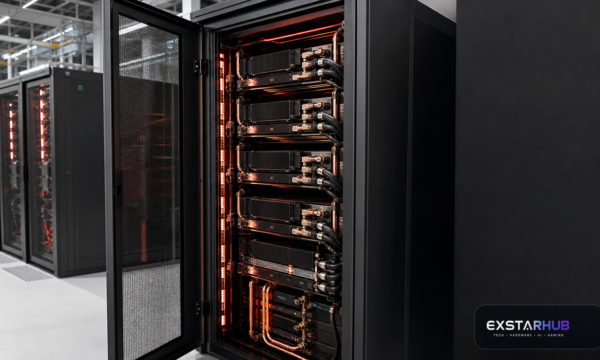
NVIDIA Rubin GPU Architecture Targets Agentic AI
NVIDIA has detailed the Rubin GPU's HBM4 memory, Transformer Engine, TMA updates, and NVLink 6 connectivity for large-scale inference and agentic workloads.
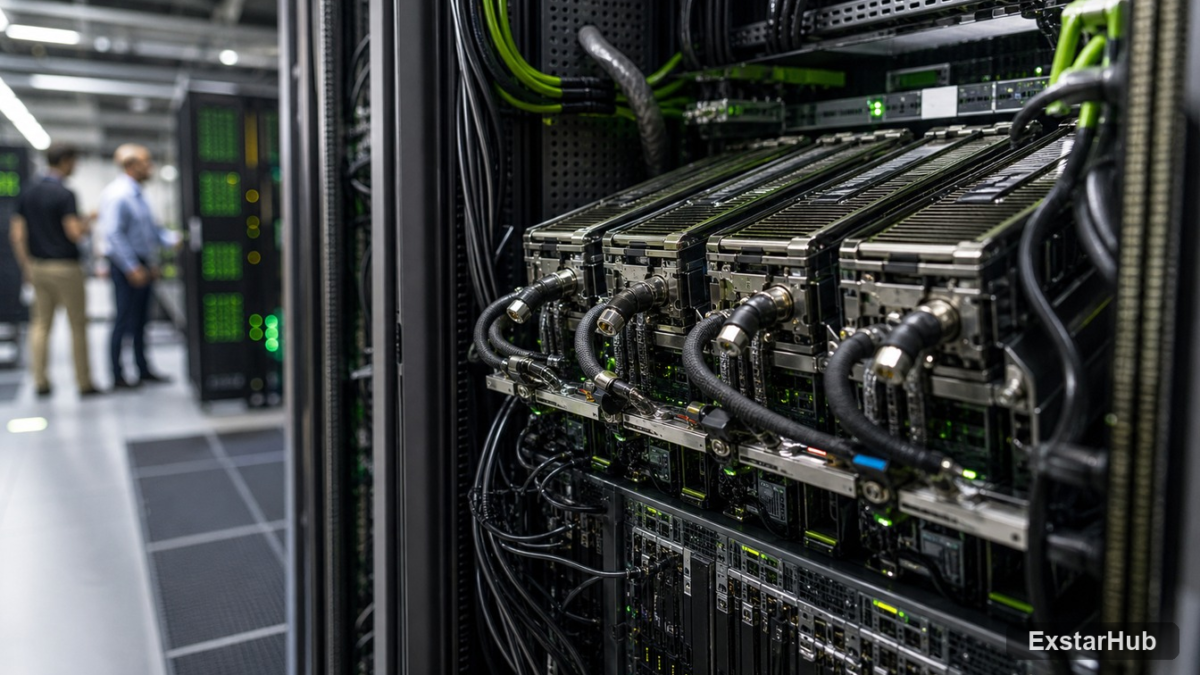
NVIDIA Rubin GPU architecture is designed for large-scale inference workloads that move repeatedly between reasoning, generation, retrieval, and tool use. In a new technical breakdown, NVIDIA detailed the GPU’s compute layout, HBM4 memory system, Tensor Memory Accelerator updates, and rack-scale connectivity.
The specifications are NVIDIA’s own performance claims, but they show where the company sees the main constraints for agentic AI: memory bandwidth, distributed communication, long-context inference, and energy-efficient token generation.
Rubin combines two compute dies
The Rubin GPU uses two reticle-limited compute dies connected in one package through NVIDIA’s High-Bandwidth Interface. NVIDIA lists 336 billion transistors, 224 streaming multiprocessors, and 896 Tensor Cores.
A third-generation Transformer Engine supports multiple numerical formats and is rated for up to 50 petaflops of NVFP4 inference performance. That figure describes peak vendor-rated performance, not the speed every model or application will achieve.
HBM4 targets the inference memory bottleneck
Rubin integrates up to 288 GB of HBM4 memory with up to 22 TB/s of peak bandwidth. NVIDIA says the wider HBM4 interface and redesigned memory controllers deliver 2.8 times the bandwidth of Blackwell and Blackwell Ultra.
Capacity and bandwidth solve different problems. More memory can keep larger models, context windows, and KV caches on the GPU, while higher bandwidth helps the token-by-token decode phase feed the compute cores. That distinction matters for agentic systems that maintain long context and execute many sequential inference steps.
TMA updates improve data movement
The enhanced Tensor Memory Accelerator manages transfers across complex tensor layouts. Rubin also introduces inline descriptor updates, allowing software to override fields such as pointers and strides directly in a TMA instruction instead of repeatedly rebuilding descriptors in memory.
NVIDIA presents this as particularly useful for Mixture-of-Experts models, where tokens must be routed among different expert networks. Reducing metadata and transfer overhead can help keep more of the GPU occupied with useful computation.
Tensor Core changes target distributed inference
Rubin doubles Tensor Core throughput per clock along the K dimension. According to NVIDIA, this reduces the number of iterations needed for matrix operations common in context processing and decoding at high tensor-parallel scales.
The benefit should be most visible when a large model is divided across many GPUs. Real-world gains will still depend on model architecture, precision, software optimization, batch size, and the rest of the system.
NVLink 6 connects the rack-scale system
Rubin provides up to 3,600 GB/s of scale-up bandwidth through NVLink 6, 1,800 GB/s for coherent CPU-GPU communication through NVLink-C2C, and up to 256 GB/s of host connectivity through x16 PCIe Gen 6.
The architecture also adds counted writes for device-initiated NVLink communication. The receiving GPU can track transfer completion with less synchronization overhead, helping communication and computation overlap during distributed inference.
Security and rack design are part of the platform
NVIDIA pairs Rubin with confidential-computing features intended to protect data at rest, in transit, and in use. At rack scale, the Vera Rubin NVL72 platform combines compute, networking, liquid cooling, power management, and serviceability.
This system-level design is important because a GPU specification alone does not determine agent performance. Network latency, memory utilization, cooling, software, and power limits all affect sustained throughput.
Why NVIDIA Rubin matters
Rubin is not limited to agentic AI, but NVIDIA is positioning agent workloads as a central design target. The architecture focuses on keeping large models supplied with data and connected across many GPUs, rather than treating peak compute as the only measure of progress.
Independent benchmarks will be needed to test NVIDIA’s efficiency and throughput claims across real models. For now, the disclosure provides a detailed view of the hardware choices behind the company’s next generation of AI infrastructure.
Key specifications
- Up to 288 GB of HBM4 memory and 22 TB/s of peak memory bandwidth.
- Up to 50 petaflops of vendor-rated NVFP4 inference performance.
- NVLink 6 scale-up bandwidth of up to 3,600 GB/s.
- NVLink-C2C bandwidth of up to 1,800 GB/s.
- x16 PCIe Gen 6 host connectivity of up to 256 GB/s.
Source: NVIDIA Developer