
GMKtec EVO-X3: The $3600 Price Tag for a Local AI Powerhouse
The new GMKtec EVO-X3 targets the high-end local AI market with AMD's powerhouse Strix Halo chip. It offers massive TOPS for inference while maintaining a compact vertical footprint.
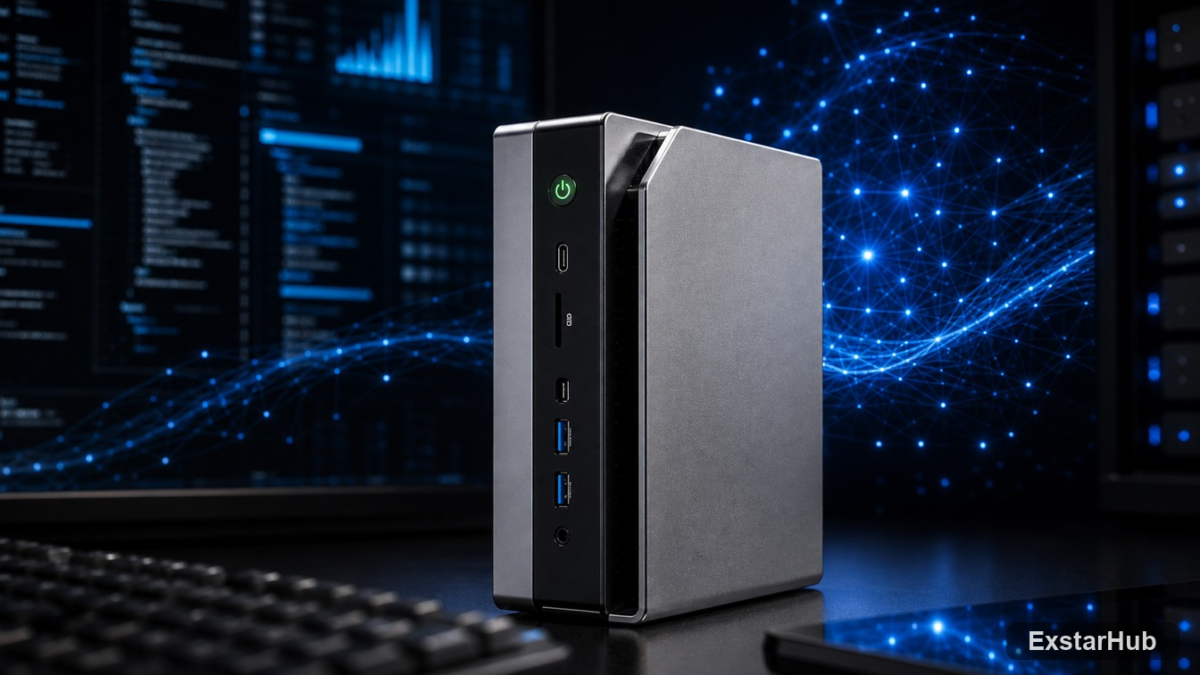
The GMKtec EVO-X3 is a compact AI workstation built around AMD’s Ryzen AI Max+ 395 processor, 128GB of unified LPDDR5X memory and Radeon 8060S graphics. GMKtec currently lists the 128GB RAM and 2TB SSD configuration for $3,600 in the United States. That makes the EVO-X3 interesting for demanding local AI workloads, but difficult to justify as an ordinary mini PC.
GMKtec EVO-X3 review: quick verdict
Based on the official specifications, the EVO-X3’s strongest feature is not a single benchmark number. It is the combination of a 16-core processor, capable integrated graphics and 128GB of fast memory in one compact system. That shared memory can accommodate models and projects that exceed the memory capacity of many consumer graphics cards.
However, this is a specifications-based assessment rather than a hands-on lab review. ExstarHub has not independently tested GMKtec’s performance claims, thermals or noise levels. At $3,600, buyers should wait for independent benchmarks unless they specifically need the EVO-X3’s unusually large unified-memory pool and compact form factor.
Ryzen AI Max+ 395 specifications
AMD’s Ryzen AI Max+ 395 combines 16 Zen 5 CPU cores and 32 threads with boost clocks up to 5.1GHz. Its integrated Radeon 8060S GPU uses 40 RDNA 3.5 compute units, while the XDNA 2 neural processing unit is rated for up to 50 TOPS. AMD and GMKtec describe total platform AI performance of up to 126 TOPS, which includes more than the NPU alone.
The distinction matters because TOPS figures from different components or vendors are not automatically comparable. Real local AI performance also depends on model size, quantization, software support, memory bandwidth and power limits.
Memory and local AI capability
The EVO-X3 includes 128GB of onboard LPDDR5X-8000 memory. GMKtec says as much as 96GB can be allocated to graphics workloads. The memory is not upgradeable, but its capacity is the main reason to consider this system for local inference, large creative projects or data-sensitive workloads.
GMKtec advertises support for large models, including 70-billion-parameter models and selected models with up to 235 billion parameters. These are manufacturer claims, not a guarantee that every model will run at a useful speed or quality setting. Context length, quantization and available software can substantially change memory use and output speed.
The company also advertises a preinstalled GMKtec Claw system for deploying local AI agents. Buyers should treat bundled software as a convenience rather than the central purchasing reason, since long-term value depends on updates, compatibility and the applications they actually use.
Storage, ports and expansion
Two M.2 2280 PCIe 4.0 x4 slots support up to 16TB of total storage, according to GMKtec. Connectivity includes a 40Gbps USB4 Type-C port, HDMI 2.1, 2.5Gb Ethernet, Wi-Fi 7, Bluetooth 5.4 and an OCuLink connection using PCIe 4.0 x4.
OCuLink provides a direct route to an external GPU and should offer lower overhead than many USB-based eGPU setups. It still exposes four PCIe lanes rather than the 16 lanes commonly used by a desktop graphics card, so the real performance impact will vary by GPU and workload. GMKtec also warns that the connection does not support hot-plugging: the system should be powered off before attaching or removing an eGPU dock.
This expansion option gives the EVO-X3 more flexibility than many compact systems, including smaller devices such as the PELADN HO5 470 mini PC. The eGPU dock and graphics card are sold separately, so they add substantially to the total cost.
What the $3,600 price buys
The listed $3,600 configuration includes 128GB of memory and a 2TB SSD. That price places the EVO-X3 in workstation territory. The premium pays for dense integration and a large unified-memory pool rather than the serviceability of a conventional desktop.
For gaming alone, a traditional desktop with a discrete GPU will usually provide a clearer upgrade path. For professional local AI work, the comparison is more nuanced: discrete cards can be faster, but cards with very large memory capacities can also be expensive. Buyers comparing the EVO-X3 with professional graphics hardware should consider total memory requirements, software compatibility and sustained performance rather than TOPS alone. Our coverage of NVIDIA RTX PRO 6000 pricing illustrates how costly high-memory discrete options can become.
Important drawbacks
- High entry price: $3,600 is difficult to justify without a workload that benefits from 128GB of unified memory.
- Non-upgradeable RAM: the onboard LPDDR5X memory cannot be replaced or expanded.
- Unverified performance claims: manufacturer comparisons need independent testing under matched settings.
- Limited internal expansion: storage is upgradeable, but CPU, GPU and memory remain integrated.
- External GPU requirements: OCuLink expansion needs a separate dock, power supply and graphics card, and hot-plugging is unsupported.
Who should consider the EVO-X3?
The GMKtec EVO-X3 makes the most sense for developers, researchers and creators who need a large shared-memory pool for local models or demanding media workloads, value a compact chassis, and already know their software runs well on AMD hardware. It is less compelling for mainstream productivity, ordinary gaming or buyers who prioritize component upgrades.
The hardware concept is genuinely distinctive, but the price makes independent thermal, noise and sustained-performance testing especially important. The specifications justify attention; they do not by themselves prove that the EVO-X3 is the best workstation at this budget.
Frequently asked questions
How much does the GMKtec EVO-X3 cost?
GMKtec currently lists the 128GB RAM and 2TB SSD configuration at $3,600 on its U.S. store. Pricing and promotions can change by region and configuration.
Does it have 126 TOPS of NPU performance?
No. AMD rates the Ryzen AI Max+ 395’s XDNA 2 NPU at up to 50 TOPS. The larger 126-TOPS figure refers to total platform AI performance across multiple processing components.
Can the EVO-X3 use an external GPU?
Yes. It includes an OCuLink PCIe 4.0 x4 port. GMKtec says the connection is not hot-pluggable, so the machine must be powered down before connecting or disconnecting the dock.
Sources: GMKtec EVO-X3 product page; AMD Ryzen AI specifications