
Why Nvidia Stock’s Falling Is Directly Linked to Meta’s Strategy
The recent downward pressure on Nvidia's valuation reveals a shift in how AI giants like Meta manage infrastructure spend. This analysis explores how Meta’s specific hardware pivots are forcing a market recalibration for the GPU leader.
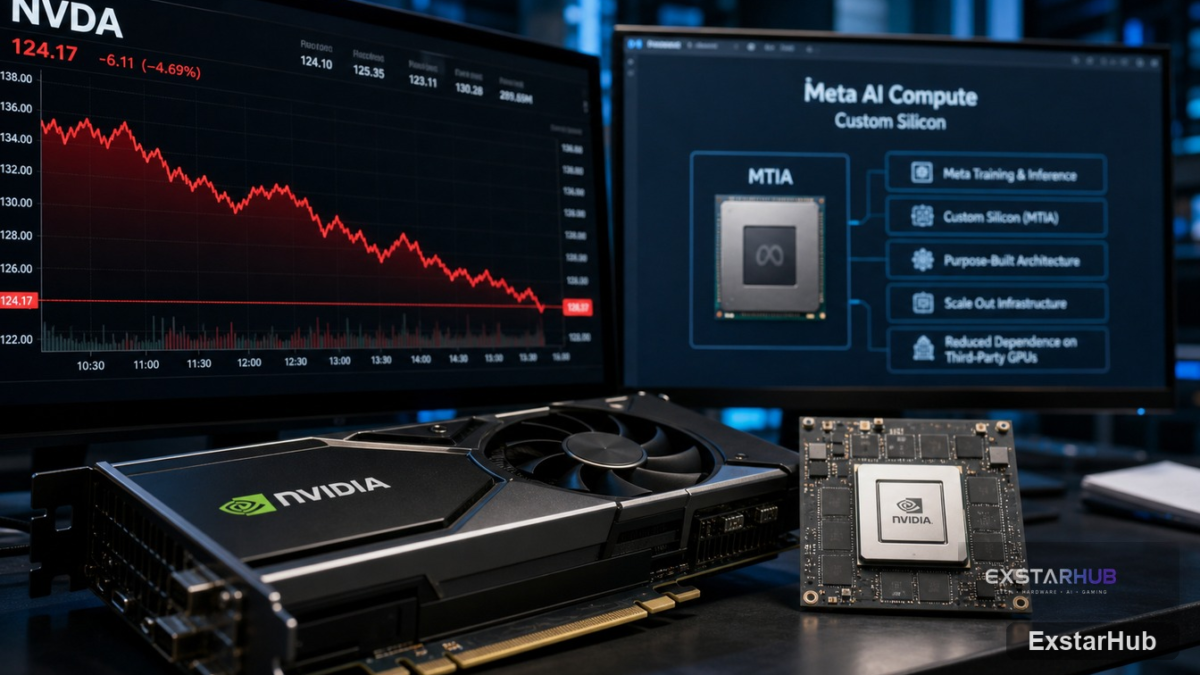
The narrative surrounding Nvidia stock’s falling is often treated as an abstract market correction, but the underlying catalyst points toward a strategic pivot by industry titans like Meta. While Nvidia remains the primary architect of the AI era, Meta’s evolving approach to hardware procurement and internal development is creating a ceiling for the growth projections that previously fueled astronomical valuations.
The Shift from Raw Buying to Architectural Autonomy
For the past several quarters, Nvidia’s dominance relied on a simple truth: every major tech firm needed as many H100s and B200s as they could get. However, Meta has begun signaling a shift toward optimizing its internal infrastructure rather than just accumulating off-the-shelf silicon. By focusing on more efficient scaling methods, Meta is effectively reducing the immediate, high-volume demand that kept Nvidia’s price action in a vertical climb.
This isn’t about Meta abandoning AI; it’s about the maturity of the enterprise. When companies move from ‘buying at any cost’ to ‘optimizing for unit economics,’ the premium on top-tier GPUs begins to face resistance. As Meta refines how it distributes compute across its massive datasets, the sheer velocity of Nvidia orders faces a natural deceleration.
Meta as an Influence Driver for GPU Pricing
Meta’s scale gives it disproportionate power over the hardware supply chain. When one of the world’s largest advertisers and infrastructure consumers begins to prioritize custom silicon or more efficient software-hardware integration, it sets a precedent for the rest of the sector. If Meta successfully proves that they can achieve their AI goals with less heavy reliance on Nvidia’s most expensive chips, other hyperscalers will follow suit.
This creates a dual pressure point: it lowers the projected top-line growth for Nvidia and forces the company to defend its margins against competitors who are trying to build ‘Nvidia-killers.’ The market is currently pricing in this transition from a gold rush—where anyone with a shovel (GPU) got rich—to an industrial era where efficiency is king.
The Valuation Gap vs. Real-World Demand
Market analysts have noted that the sheer magnitude of Nvidia’s valuation requires near-perfect execution and infinite demand growth to sustain. Meta’s strategic choices highlight a reality where AI infrastructure is becoming a utility rather than a speculative luxury. As Meta focuses on making its AI models more performant per dollar spent, the ‘scarcity premium’ that once boosted Nvidia stock’s falling price action begins to evaporate.
Why it matters
This shift marks the end of the easy growth phase for hardware giants. It matters because it signals a transition into an era of ‘hardware pragmatism.’ For investors and tech enthusiasts alike, it means that Nvidia’s future value will no longer be tied to how much hardware Meta *can* buy, but on how efficiently Meta (and its peers) can deploy what they already have. We are moving from a supply-constrained market to a demand-optimized one, where the winner is determined by software efficiency as much as raw TFLOPS.
Key takeaways
- Meta’s shift toward architectural optimization reduces the need for constant high-volume GPU procurement.
- The hardware market is transitioning from a ‘growth at any cost’ model to one focused on unit economics.
- Nvidia faces increased competition as hyperscalers look for ways to reduce their dependence on third-party silicon.
- Market sentiment is recalibrating based on how effectively large firms can scale AI without infinite spending.
FAQ
Is Meta moving away from Nvidia hardware entirely?
No, but Meta is increasingly focused on optimizing its infrastructure and exploring custom silicon solutions to manage costs as their AI needs mature.
What is causing the downward pressure on Nvidia’s stock?
While many factors contribute, a primary driver is the realization that major clients like Meta are finding ways to be more efficient with their hardware spending, cooling the previous hyper-growth expectations.
Conclusion
The reality of Nvidia stock’s falling isn’t necessarily a failure of technology, but a maturing of the market. As Meta leads the charge toward efficiency, Nvidia must prove it can remain indispensable in an era where every dollar of compute is scrutinized for its actual ROI.
Source: Barron's