
Meta’s AI Cloud Ambitions: The Economics of a Cheaper Compute Landlord
New data suggests Meta Platforms is building AI infrastructure at nearly half the previously expected cost, fundamentally altering its potential to challenge cloud giants like Amazon and CoreWeave.
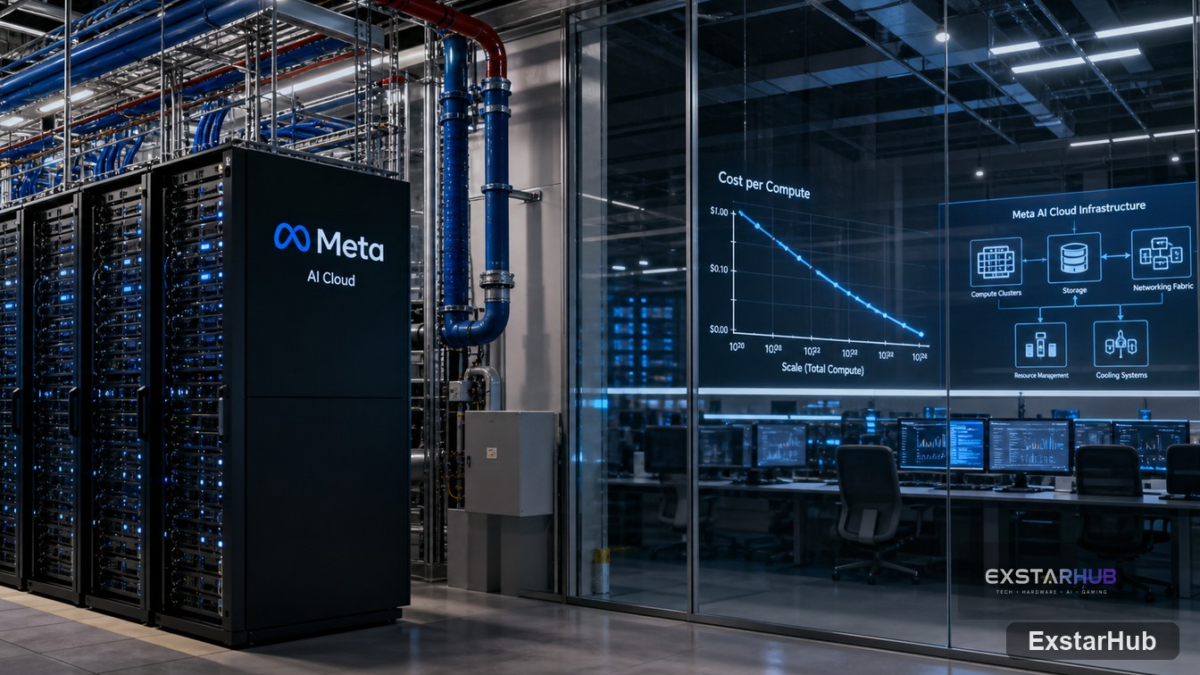
The market is finally pricing in a reality check for the heavy spending at Meta Platforms: building an AI cloud isn’t nearly as expensive as we thought. Shares of Meta Platforms jumped 6% on Friday morning, moving from $631.48 to $670, as new data suggests that Mark Zuckerberg’s pivot toward becoming a compute landlord is backed by much leaner capital requirements than the Street had previously modeled.
The Efficiency Arbitrage in AI Infrastructure
For months, investors viewed Meta’s massive capex commitments—projected to hit between $125 billion and $145 billion for 2026—as a potential bottomless pit of capital expenditure. However, a Reuters-reported internal memo combined with a fresh Bank of America note has fundamentally reframed the narrative. The reports indicate that Meta is building AI capacity at approximately $22 billion per gigawatt.
This figure is staggering when contrasted with Bank of America’s prior estimate of nearly $45 billion per gigawatt. By effectively cutting these build costs in half, Meta has significantly improved the unit economics of its massive infrastructure rollout. This isn’t just a minor optimization or a technical win; it fundamentally changes the economic viability of Meta renting out idle GPU capacity as a commercial cloud service. If the math holds, Meta can scale faster and with higher margins than its peers.
A Credible Threat to Amazon and CoreWeave
Meta is now positioned to occupy a unique and dangerous middle ground in the global compute market. Zuckerberg has already floated plans to offer both raw compute rentals—a direct play against neocloud provider CoreWeave—and hosted models, which would compete directly with services like Amazon Web Services (AWS) Bedrock. While AWS recently saw its fastest growth in 15 quarters with $37.59 billion in Q1 2026 revenue, Meta’s lower build costs provide a much leaner path to rapid scaling.
The irony of this emerging competition is the current symbiotic relationship between these tech giants. CoreWeave currently holds a massive $99.4 billion revenue backlog, which includes a $35.2 billion total commitment from Meta itself. If Meta successfully transitions into a compute landlord using its more efficient infrastructure, it effectively flips that dynamic overnight, moving from a primary customer to a direct market rival in the cloud space.
The Long Game: Iris Silicon and Regulatory Tailwinds
While the current price action is driven by immediate cost efficiencies, the long-term structural story involves Meta’s custom silicon. The Iris chip is set to enter manufacturing with Broadcom and Taiwan Semiconductor (TSMC) this fall. However, it is crucial for investors to understand that Bank of America views Iris as a 2027-plus cost savings driver rather than a primary catalyst for the 2026 fiscal year.
Additionally, the market is currently pricing away a significant regulatory overhang that could impact Meta’s bottom line. The European Commission issued preliminary findings suggesting Instagram and Facebook breached the Digital Services Act via addictive design features. This could result in fines exceeding $12 billion—up to 6% of global turnover—but for now, the bullish momentum on Meta’s capex efficiency seems to be outweighing these legal concerns in the eyes of traders.
Why it matters
This shift is critical because it validates a ‘high-scale, low-cost’ thesis for AI infrastructure that many thought was impossible. If Meta can deploy gigawatts of power at half the industry average, it proves that extreme vertical integration—owning the chips (Iris), the physical hardware, and the cloud layer—is the only way to achieve sustainable margins in an AI-driven economy. It moves Meta from being a company that simply uses AI tools to one that defines the utility of AI for everyone else.
For competitors like Amazon and CoreWeave, this means they are no longer just fighting for software dominance or user attention; they are facing a competitor who can build the underlying ‘pipes’ more cheaply than the market expected. Meta is positioning itself to own the infrastructure layer while maintaining its massive social graph, creating a dual-moat that neither of its competitors can easily replicate.
Key takeaways
- Meta’s AI build cost is roughly $22 billion per gigawatt, nearly 50% lower than previous estimates.
- The improved unit economics make the transition to a compute landlord economically viable for Meta.
- Meta poses a direct threat to both AWS (hosted models) and CoreWeave (raw compute).
- Custom chip ‘Iris’ is a long-term 2027+ play, not a 2026 revenue driver.
- Markets are currently shrugging off a potential $12 billion EU fine regarding addictive design.
FAQ
What is the difference between Meta’s proposed cloud offerings?
Meta has suggested two types of services: raw compute rentals, which mirror CoreWeave’s business model, and hosted models, which would function similarly to Amazon Web Services Bedrock.
When will Meta’s custom Iris chip be available?
The Iris chip is scheduled to enter manufacturing with Broadcom and TSMC this fall, though analysts expect its primary impact on cost savings to appear from 2027 onwards.
How does the new build cost compare to previous estimates?
New reports suggest Meta is building capacity at $22 billion per gigawatt, a significant reduction from Bank of America’s earlier estimate of nearly $45 billion per gigawatt.
The bull case just got cheaper to underwrite as Meta proves it can build the future of AI infrastructure on a leaner budget. While regulatory risks remain, the shift toward becoming a compute landlord provides a much more aggressive growth trajectory than many analysts originally predicted.
Source: 24/7 Wall St.