
Alphabet AI Spending Sends Free Cash Flow Negative
Alphabet reported negative quarterly free cash flow after capital spending reached $44.9 billion, even as Google Cloud revenue jumped 82%. The figures show both the demand behind its AI buildout and the growing cost of funding it.
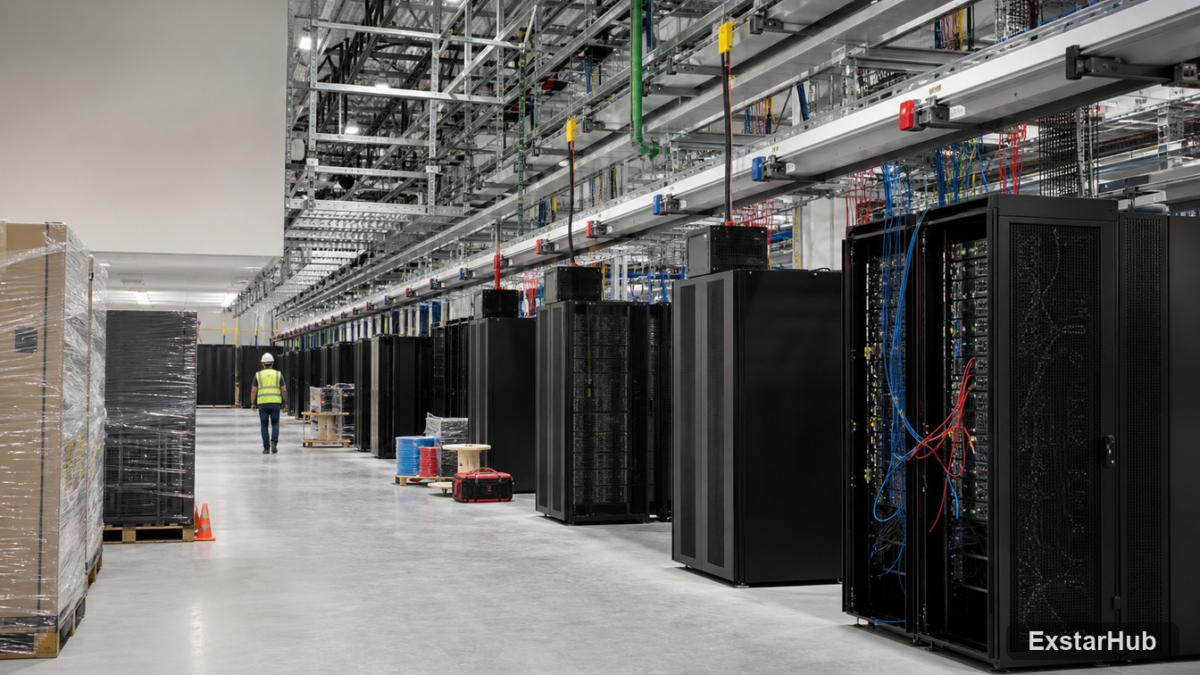
Alphabet AI spending pushed the Google parent into negative quarterly free cash flow for the first time in its reported history, even as revenue and operating profit rose sharply. Alphabet generated $39.1 billion in operating cash during the second quarter of 2026 but spent $44.9 billion on property and equipment, producing negative free cash flow of $5.9 billion.
The result is not evidence that Alphabet’s core business stopped making money. The company reported $40.8 billion in operating income on $119.8 billion in revenue. It does show how quickly spending on data centers, chips, networking and related infrastructure can absorb the cash generated by an otherwise highly profitable business.
Alphabet AI spending overtook operating cash flow
Alphabet defines free cash flow as cash generated by operations minus purchases of property and equipment. Its earnings release shows operating cash flow of $39.069 billion and capital expenditures of $44.924 billion for the quarter ended June 30. That left free cash flow at negative $5.855 billion, down from positive $10.116 billion in the first quarter.
Capital spending more than doubled from $22.446 billion a year earlier. The comparison explains why the cash-flow figure changed so dramatically even though the underlying businesses continued to expand.
Alphabet also raised its full-year 2026 capital-expenditure forecast to between $195 billion and $205 billion, up from its previous range of $180 billion to $190 billion. Reuters reported that management expects spending to increase again in 2027. Those are company forecasts rather than guaranteed outcomes, and actual spending can change with construction schedules, equipment deliveries and demand.
Cloud growth is the clearest argument for the buildout
Google Cloud revenue increased 82% year over year to $24.8 billion, while the segment’s operating income rose to $8.8 billion from $2.8 billion. Alphabet attributed the acceleration to demand for Google Cloud Platform services, including enterprise AI infrastructure and AI solutions.
That growth gives the company a stronger commercial case for adding capacity. More servers can support Google Cloud customers as well as Search, Gemini, YouTube and internal model development. It also means the spending cannot be judged only against one quarter’s revenue: data-center assets are designed to support workloads over several years.
The uncertainty is whether demand, pricing and utilization will remain strong enough to earn an attractive return on a much larger asset base. ExstarHub has previously examined the same tension in Meta’s expanding data-center costs, where the strategic need for capacity must be weighed against power, construction and financing commitments.
Headline net income needs important context
Alphabet reported $112.1 billion in net income available to common shareholders, nearly four times the prior-year figure. Most of that increase did not come from day-to-day operations. The company recorded a $99.0 billion net gain on equity securities, which increased net income by $77.1 billion after tax.
Reuters reported that much of the gain was connected to Alphabet’s investment in SpaceX. Alphabet’s filing itself does not name the company in its earnings tables, so the attribution should be treated as Reuters’ reporting rather than a separate disclosure from Alphabet.
Unrealized investment gains can move sharply with private and public market valuations. They increased accounting profit this quarter, but they did not prevent free cash flow from turning negative because free cash flow measures operating cash after capital investment, not changes in the carrying value of equity holdings.
Alphabet is using its balance sheet to keep building
The company ended June with $242.5 billion in cash, cash equivalents and marketable securities. It also raised $49.6 billion through common and mandatory convertible preferred stock during the quarter and issued senior unsecured notes for net proceeds of $20.3 billion. Alphabet said the equity proceeds would support general corporate purposes, including AI infrastructure and global compute.
This financing activity matters because the AI buildout is becoming too large to view as routine equipment replacement. Alphabet is deliberately combining operating cash, debt and new equity capital to bring capacity online faster. That may preserve strategic flexibility, but it also raises the standard for future returns.
The same infrastructure race is widening across the industry. Microsoft, for example, is adding alternative full-rack systems through its planned AMD Helios deployment on Azure. Reuters, using analyst estimates, reported that major hyperscalers could spend more than $700 billion in capital expenditures during 2026, although company definitions make direct comparisons imperfect and not all capital spending is exclusively for AI.
What investors and customers should watch next
One negative quarter does not establish a permanent cash-flow trend. Alphabet still produced $53.3 billion in free cash flow over the trailing 12 months, according to its earnings release. Future results will depend on how quickly new facilities enter service, how heavily they are used, and whether cloud and advertising growth continue to finance the buildout.
Three measures will be especially useful: quarterly capital expenditures, Google Cloud operating profit, and free cash flow before financing activity. Rising cloud revenue without corresponding gains in utilization or cash generation would make the investment case harder to defend. Continued profit growth alongside improving capacity use would support Alphabet’s argument that the spending is building a durable AI platform.
Why it matters
Alphabet’s quarter captures the central trade-off in the current AI race. Demand is real enough to drive Google Cloud growth, but supplying that demand requires infrastructure on a scale that can temporarily consume more cash than the company generates from operations.
The result should not be reduced to either a crisis or an automatic success. Alphabet remains profitable and highly liquid, while its negative quarterly free cash flow provides a concrete measure of the cost. The next test is whether the assets now being built produce sustained revenue and cash returns after the construction surge passes.
Source: Reuters