
Danuri Captures the Impact Site of a SpaceX Falcon 9 Stage
South Korea’s Danuri lunar orbiter imaged the aftermath after a spent Falcon 9 upper stage struck the Moon on August 5.
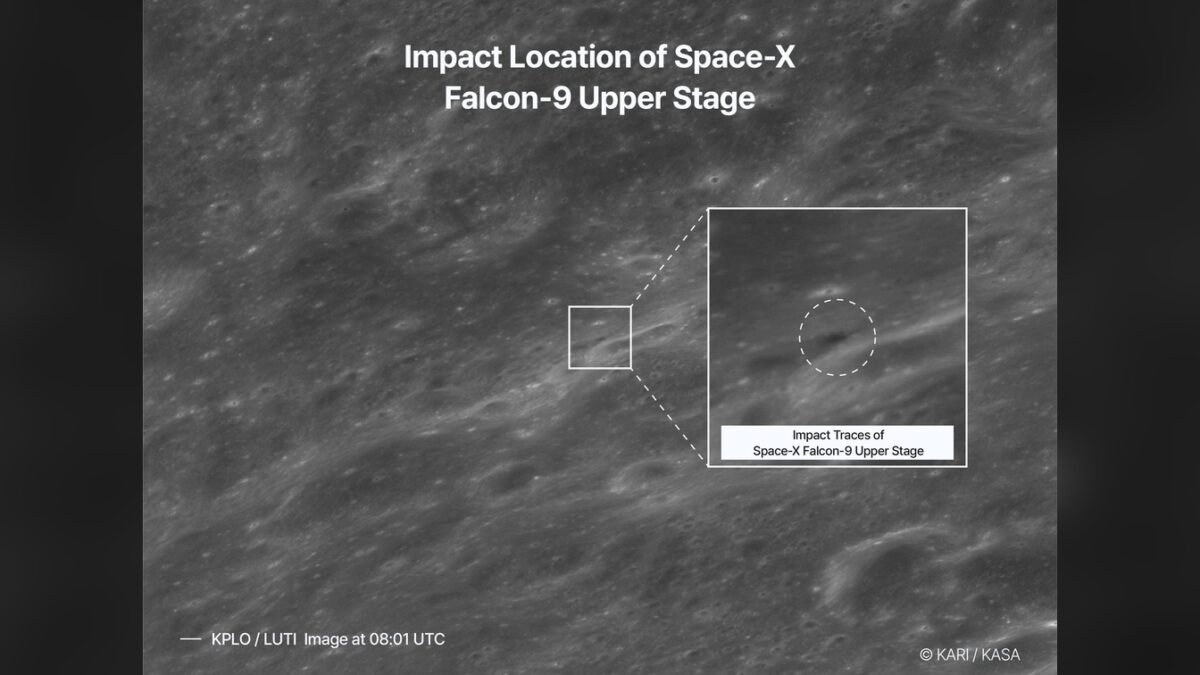
South Korea’s Danuri lunar orbiter has returned images of the location where a spent SpaceX Falcon 9 upper stage struck the Moon on August 5. The impact was not part of a planned lunar mission: the rocket body had been on a trajectory that eventually carried it into the lunar surface.
The Associated Press reported that the upper stage hit at about 5,400 mph (8,700 kph). The Korea Aerospace Research Institute (KARI) then used Danuri, formally the Korea Pathfinder Lunar Orbiter, to observe the site from lunar orbit.
What Danuri captured
KARI’s official imagery identifies the impact location and includes a before-and-after comparison of the surrounding terrain. In a separate comparison image, the agency placed its new observation alongside an older Lunar Reconnaissance Orbiter image from NASA. These are scientific orbital observations of the surface, not photographs of the moment of impact or of an intact rocket.
According to reporting on KARI’s announcement, Danuri began observing about 30 minutes before the collision and made multiple passes over the area. KARI said it obtained pre-impact and immediate post-impact imagery, allowing researchers to compare changes in the terrain and ejecta around the site.
How the stage reached the Moon
The stage was left over from a Falcon 9 launch that carried private lunar landers in 2025. Unlike the reusable first stage, an upper stage is normally expended. In this case, the rocket body remained in a high Earth orbit after its mission. AP reported that solar activity and gravity later placed it on an accidental collision course with the Moon.
That distinction matters. The event was not an attempt to deliberately crash hardware into the lunar surface, and Danuri’s images should not be read as evidence of a new SpaceX landing or lunar program. They document the aftermath of an unplanned impact by a spent launch stage.
Why the images are useful
The before-and-after sequence gives researchers a rare data point for understanding how a known piece of hardware alters the lunar surface. It also highlights a practical issue for an increasingly busy region of space: objects placed on distant orbits can remain there long after their primary mission has ended.
The images do not settle every detail of the impact. They show the location and surface changes at the resolution available to Danuri’s instrument; they do not provide a close-up inspection of debris. NASA’s Lunar Reconnaissance Orbiter was expected to make a later pass over the area, according to AP, which could add another independent look at the site.
What to watch next
The important next step is scientific follow-up, not speculation from the headline. KARI’s observations can be compared with later orbital measurements to refine estimates of the impact site, crater and material ejected from the surface. That work may also help future planners assess the path and final disposition of hardware sent into cislunar space.
The official KARI graphics used with this article are the real Danuri observations and retain the agency’s source labels. They are not recreated visualizations, stock lunar scenes or fabricated depictions of the collision.
Sources
- The Associated Press: South Korean satellite captures SpaceX stage impact site
- Korea Aerospace Research Institute: Danuri impact observations
- Space.com: KARI observation details and image context
- KARI: Danuri lunar-exploration mission
Source: WION