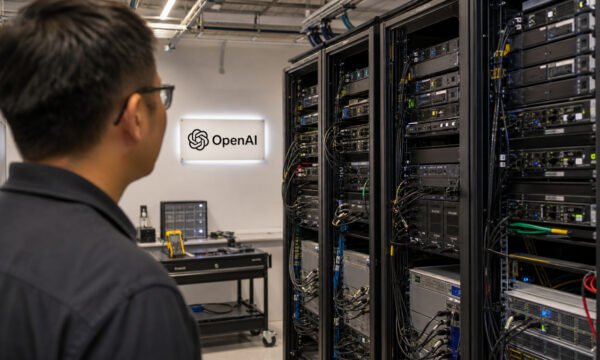
NVIDIA Targets $500B for AI Compute Financing
NVIDIA says it has signed memorandums of understanding with six finance firms to create AI-compute financing platforms targeting more than $500 billion in third-party capital over time.
NVIDIA says it is working with Apollo, BlackRock, Blackstone, Brookfield, Goldman Sachs and KKR to create financing platforms for AI compute. The company says the arrangements are intended to mobilize more than $500 billion in third-party capital over time for AI infrastructure.
The announcement is significant because it frames large-scale AI compute as an asset that can be financed for customers, rather than only bought outright by a small group of cloud providers and AI labs. But the headline figure is a target for capital the proposed platforms could mobilize, not a $500 billion cash commitment that has already been funded or deployed.
What NVIDIA announced
According to NVIDIA’s August 10 press release, the company signed memorandums of understanding with the six firms to establish independent compute-financing platforms. NVIDIA says the proposed platforms would create dedicated pools of capital for its customers at what it describes as attractive rates.
The company ties the plan to the construction of “AI factories” — its term for infrastructure that combines accelerated compute, networking, software, power and cooling for AI workloads. NVIDIA says the platforms are meant to broaden access to that capacity across its ecosystem, which includes AI labs, enterprises and AI-cloud operators.
Final agreements have not yet been executed. NVIDIA’s release does not identify specific projects, borrowers, locations, financing terms or a timetable for bringing the full amount of capital into use. Those details matter when judging how quickly the proposal could translate into new data-center capacity.
Why financing is central to the AI buildout
Training and operating advanced AI systems requires expensive infrastructure: chips, servers, networks, electricity, cooling, buildings and long-term operations. Financing can spread those costs over time and may make it easier for customers to acquire capacity without treating every system purchase as a single upfront outlay.
NVIDIA’s pitch is that its compute and full-stack software ecosystem can support usage-linked, long-duration infrastructure economics. That is a commercial argument from the company, not a guarantee of revenue or asset performance. The proposed funding platforms will still need final agreements, underwriting and customers willing to use the capacity.
What the $500 billion figure means — and what it does not
The number describes third-party capital NVIDIA and its partners aim to mobilize over time. It should not be read as an immediate NVIDIA investment, a government-backed program, or proof that $500 billion of new AI factories are already under construction.
The named institutions have different roles in global credit, private markets and infrastructure investment. NVIDIA’s announcement says their collaboration is intended to make pools of capital available for compute infrastructure; it does not disclose each firm’s individual commitment or allocation.
What comes next
For NVIDIA, the proposal extends its role beyond selling chips and systems into helping customers finance the infrastructure those products run in. For the financial partners, it is a bet that AI compute can be structured as a long-lived infrastructure category.
The next milestones to watch are final financing agreements, disclosed projects and the terms offered to customers. Until then, the announcement is a high-level framework for funding the AI buildout, rather than a completed half-trillion-dollar deployment.
Sources
Source: BBC