
Why Google and Apple Are Fighting the EU Over AI Assistants
New EU interoperability rules are forcing Google to open key Android features to rival AI assistants, while Apple says the same legal principle is delaying Siri AI in Europe.
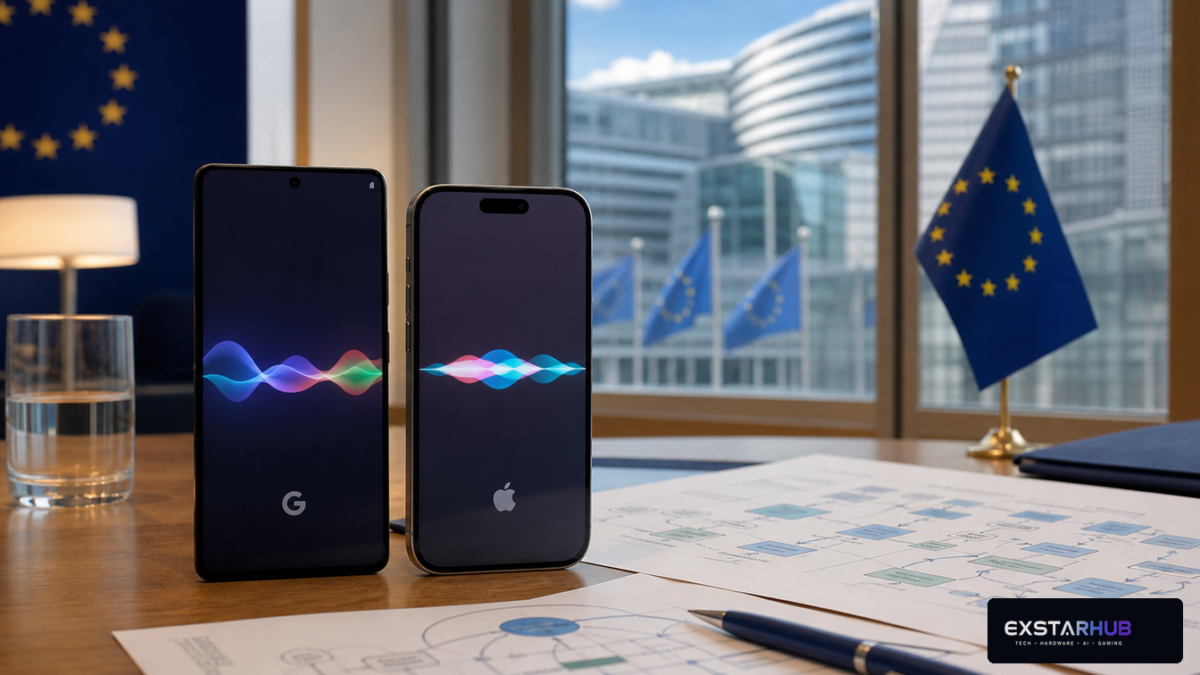
Europe’s effort to open mobile platforms to rival AI assistants has put both Google and Apple in conflict with regulators, but the two companies are not facing the same proceeding. On 16 July 2026, the European Commission adopted binding measures telling Google how it must provide competing AI services with access to key Android features. Apple, meanwhile, has blamed the same Digital Markets Act interoperability principle for delaying Siri AI on iPhone and iPad in the EU.
The common issue is platform access. As AI assistants become capable of reading on-screen context, invoking apps and completing actions, control of the mobile operating system can determine which assistant delivers the most useful experience. The EU’s position is that designated gatekeepers cannot reserve those advantages for their own services.
What the EU ordered Google to change
The Commission’s Google decision follows specification proceedings opened on 27 January 2026. It covers 11 Android features that the regulator considers important for competitive AI services, including assistant invocation, contextual information, actions across apps and access to device resources.
In practical terms, a user should eventually be able to activate a chosen third-party assistant with a wake word, invoke it through system access points and authorise it to carry out tasks in other apps. The Commission says these functions are currently available more deeply to Gemini than to user-installed alternatives.
The measures also address Google Search. Google must provide eligible third-party search engines with access to anonymised ranking, query, click and view data on fair terms. The Commission clarified that AI chatbots with search functionality can qualify, while allowing Google to assess serious cybersecurity and data-protection risks before sharing data.
This does not make Google’s search data public or remove privacy safeguards. The decision specifies anonymisation, access conditions and a pricing formula. It is a regulated data-sharing framework rather than an open database.
Why Apple is part of the same argument
Apple’s dispute is separate but built around the same DMA obligation. On 8 June, Apple said Siri AI would not launch on iPhone and iPad in the EU alongside iOS 27 and iPadOS 27. The company argued that regulators’ interpretation would require it to give other virtual assistants access to private user data and control over installed apps without protections Apple considered sufficient.
The European Commission rejected the idea that the DMA prohibits Siri AI. It said the decision not to launch was Apple’s and noted that the law requires equivalent access for third parties, subject to user consent. Apple has published a developer process for requesting interoperability with iOS and iPadOS features, but the two sides remain divided over what safe, effective access should look like.
The real contest is over the default AI layer
Google’s advantage is not only the quality of Gemini. Android gives it distribution and access to system functions that can make an assistant faster and more capable. ExstarHub’s coverage of Google I/O 2026 showed how the company is expanding Gemini into an always-on agent across Search, Android and third-party apps.
Apple is building toward a similarly integrated experience with Siri AI. For both companies, the regulatory question is whether rivals must receive functionally equivalent hooks into the operating system. For users, that could mean more choice, but it also makes consent design, security boundaries and accountability more important.
What happens next
Google must implement the Commission’s binding measures on a timetable that extends into 2027. The company has warned that the requirements could weaken privacy and security safeguards, while the Commission says its decision preserves user consent, device integrity and EU data-protection rules.
The disagreement is therefore not simply regulation versus innovation. It is a dispute over who defines safe access to the most powerful layer of a smartphone. That same tension is appearing across the AI industry, as ExstarHub has also examined in its coverage of AI governance frameworks and EU rules. The outcome will shape whether mobile AI develops as a collection of competing assistants or remains tightly coupled to the company that controls each operating system.
Source: CNN